Eerily deserted
The sign on the gate had said ‘Wolford Wood’, as expected. There was the row of wheelbarrows, as described, to assist with porting camping equipment from the car-park. Over a hedge I could just see what looked like the roof of one of the advertised glamping cabins. There could be no doubt we were in the right place, but there was not a human soul to be seen.
Hens pecked around a wooden building with a row of washing-up sinks along an outside wall. Upside-down mugs were neatly arranged on the draining rack, next to three half-full bottles of washing-up liquid, a collection of sponges and a large pot of instant coffee. Next to the building were a couple of picnic benches. Beyond was a meadow, shin-deep with wild grass, dotted with buttercups and plastic sheaths containing bamboo canes for newly-planted saplings. Beyond the field was a wood, presumably the ancient, private area of woodland that I knew was part of the site. The trees at the edge of the wood also looked recently planted; they were about eight feet tall. Their leaves had a brownish tinge, at odds with the lush, spring green of the wider surroundings. Beyond these saplings were mature trees, but some of them also had leaves of an unsettling colour: this time ghostly pale. The wind blew first hot, then cold air across the meadow and cloud shadows occasionally darkened the harsh midday sunlight. Leaving my wife Sarah with the car, I let myself into the meadow, and then turned onto a white, stoney track to take a closer look at the glamping cabins. My search found no sign of any people, just an ancient tractor with wooden pallets on what remained of the seat.
I turned back, and another cold gust of wind whipped up a cloud of white dust from the track in front of me. The gust passed, and the heat of the sun returned. This campsite had been recommended by a blogger as being ‘the best in the Cotswolds to reconnect with nature.’ Why was it giving me the creeps? I couldn’t resist the feeling that it had been recently evacuated.
We found a spot in the meadow which looked like it had been camped in before, and started to wheel our kit over from the car. There seemed no obvious reason not to stay. I suspected the uneasy feeling had more to do with me than the campsite. Maybe I would feel better after some lunch. Maybe the eerie feeling of quiet was something to do with the fact we had dropped the kids off at my sister’s just over an hour before. Maybe the feeling of tension was linked to the fact that I had possibly never in my life felt quite to desperate to relax and ‘connect with nature’.
Looking for connection with nature
I had been reading and listening to a lot of people involved in climate campaigning and activism over the last few months. Taking time to ‘connect with nature’ seemed to be of great importance to many of them: it allowed them a chance to slow down and zone out from their work, the urgency and overwhelming nature of which could easily lead to burnout, while also making sure they maintain their love for Earth and its living riches, and keep their motivation alive.
The last few months had been turbulent. A succession of events across the winter had shown me how, due to my feelings and opinions on the climate crisis, a career as an airline pilot no longer made sense for me. A frenzy of activity and emotions had followed, as major aspects of my future, which had seemed quite stable and predictable, were plunged into uncertainty. Recently, it had felt like the load of trying to manage the instability and think about the looming decisions, while getting on with normal family life and trying to continue flying, was becoming too much, The correct, safe decision as a pilot, possibly the last of my career, was to tell my aviation medical examiner I was too stressed to fly, and get my licence suspended. It had been just over a week since I had last flown. Under normal circumstances, I would at this very moment have been just starting back from Las Palmas.

Stressed trees?
I did feel a little better after lunch. Those odd coloured trees still bothered me though. They reminded me of the trees in the summer of 2022, when the record-breaking heatwave had caused many leaves to turn brown or even fall in August. With my head full of those books and podcasts on climate change, I was already worried by this spring’s exceptional dry spell and I couldn’t help wondering if, in looking towards nature to help me relax and de-stress, I had found it struggling with stress of its own.
Fortunately, the tops of the trees in the woodland beyond this patch looked vibrant and healthy. Maybe there was nothing to worry about. A spot of forest-bathing under that green canopy would surely do us some good, so off we set, down the track.
On the very edge of the wood, the track took us through a clearing where three or four diggers were sitting idle near to the timber frame of a large building. It looked like the kind of place that would usually be fenced-off, but there was no sign or barrier and it was the only way we could see into the wood, so we carried on.
Just after we’d left the clearing, we heard a car pull up into it, a door open and a lady call, ‘Hello?’
‘Hi,’ we called back, fearing that our walk, and maybe our camping weekend, might be over.
‘Are you camping here?’ the lady asked, still hidden from us by some shrubs. ‘Yes’.
‘Wonderful! I love that you’re camping here, otherwise I should have had to tell you to walk somewhere else!’
The lady came into view; a hippy with long hair, a knitted cardigan and light, patterned skirt which floated around her ankles. She looked very connected with nature indeed. I wondered, had she always been like this, or was this the result of thousands of hours spent in this wood?
‘Would you like me to show you around?’
We replied that we very much would.
We introduced ourselves. Her name was Petra, and she proceeded to tell us what we would see if we walked down each of the paths that diverged from this point. On the northerly path, if we turned off it to the right, just as it crested a ridge, we would find an ancient oak which, centuries ago, had been coppiced so that it now had five trunks.
‘You can walk between them! It’s bigger than this one.’ She gestured at a magnificent tree with just one, enormous trunk behind her left shoulder.
She told us where there would be bluebells, where paths linked to other paths, and where we might find dead ends.
‘At the end of this path there’s are field, but don’t go into the field, or if you do, don’t say you’re from here. But go exploring, lose yourselves!’ She looked doubtfully at our bare legs and footwear: I was wearing crocs and Sarah canvas trainers.
‘You’ll be ok. I mostly get a bit scratched but it’s nothing. I got these bites the other day though.’ She lifted her skirt up to her knees to show some slightly angry-looking red marks on her shins. ‘I’ll keep an eye on them,’ she said. ‘I think they’ll be ok in a day or two.’
Sarah looked at them critically and gave a guardedly reassuring reply.
‘So what are you two?’ Petra asked, ‘Doctors? Nurses? Vets?’
I laughed. ‘Sarah’s a vet.’
‘I thought so. You sounded like you know what you’re talking about. If you have any time, I’m slightly worried about the skin on one of my pigs. He’s probably fine, but he isn’t quite as hairy on top as his sisters.’
Sarah promised to have a look over the fence, and to let her know if she saw anything concerning, caveating that it had been many years since she had done any work with pigs.
‘And what about you, what do you do?’ Petra asked.
‘I’m a pilot,’ I replied, out of habit, and immediately regretted it. I couldn’t imagine somebody like Petra having much time for airlines and people who worked for them. But, if she was as disgusted as I feared she might be, she hid it admirably.
‘Oh right!’ she said. ‘It’s not for me but my kids love it, they just came back from Miami so I do get it, it’s fun to fly around.’
‘I’m not sure it’s really for me any more’, I said desperately. ‘I’m thinking of getting out.’
‘The trains are great now,’ Petra went on. ‘They’ve just started a really fast train to Berlin I think.’
She went on to tell us about another corner of the wood, where they were having to do a lot of management due to ash dieback. Given that opportunity, I had to ask about the odd-coloured leaves on the trees by the meadow.
‘The trees with pale and browny coloured leaves near where we have pitched our tent,’ I said. ‘Is that because they’re a bit stressed, or struggling a bit, or what is it?’
Petra appeared slightly horrified that I might doubt the vitality of her trees. ‘No no, those are aspens, they’re supposed to be that colour!’
I told Petra how pleased I was to hear that - I really did feel quite relieved - and confessed that my tree recognition skills were very poor. Petra continued to talk passionately about some of features of the leaves and types of trees within a few yards of where we stood.
We chatted for a few more minutes, and then she sent us on her way, very amicably, I thought, considering that I had just insulted her beloved, beautiful and clearly thriving woodland, and given away that I worked for an airline. Thank heavens Sarah had agreed to look at her pig!
Looking for direction: one career ends, another begins?
We walked down the path, found the oak with five trunks. A single bluebell was growing from the base of one of them. High overhead, the tree-tops whispered. We stood in the middle of the trunks, leant back against them, closed our eyes and took deep breaths. The meadow’s muddled, tetchy wind had been settled by the wood into a soft, warm, scented breeze. Spots of sunlight that found their way through the leaves and branches leaped and frolicked on the bark of tree trunks and the grassy forest floor.
I was still fretting a bit though. If I was seriously thinking about ending my flying career, what might have been a better answer to Petra’s question? What might be my answer next time somebody asks me what I do? The idea for Look Near First had formed in my mind several weeks before, but I still didn’t have much idea of how best to proceed with it.
‘Why don’t you say you’re a travel blogger?’ Sarah suggested.
‘Wouldn’t I have to have written at least one blog to say that?’ I asked.
‘Well, do that then.’

Finding connection with nature
We walked on. Many areas were thick with bluebells. We reached the edge of the wood and turned right, through a gate which confirmed we had found a public footpath. The footpath took us back into the wood and shortly after, split in two. We chose the left path, which took us to a pond and then petered out. Rather than turning back, we turned right again to follow an animal track, rutted with deer spoor, hoping to find the right path again. We came to a ditch, full of water and awkward to cross, and gave each other a steadying hand across it. We found the footpath, and followed it to a corner of the wood where there was a dense patch of wild garlic. Sarah suggested taking some back to have with our bolognaise that evening. Beyond blackberry picking, wild foraging is well out of my comfort zone, but she seemed very confident, so we put some leaves in our pockets.
We started to meander our way back through the middle of the wood. Although I will admit to being pretty clueless when it comes to wild foraging or plant recognition, over the last three years I have made some progress in learning to recognise bird sounds. At this moment, I could hear a blackbird, a chiffchaff and a goldcrest, plus one more strong, distinctive call, a bit like a car alarm, which I couldn’t identify. My Merlin app told me it was a nuthatch.
I get a small thrill every time I am able to exercise my new ability to recognise a few common birds by sound. I suppose there’s something mindful about it: it interrupts whatever else might have been occupying my mind and brings me right into the present for a few seconds. Not long after I’d started trying to learn, I began to notice, much more than I had done before, the changes in birdsong over the course of the year. I had known about listening for the first cuckoo of spring, but now I realised how much quieter the birds become in the late summer and autumn, and how the spring songs start to build almost as soon as the days begin to lengthen. Now, I consciously listen out for the clear, ringing song of a great tit, as the first clear sign of the coming spring, as soon as we are in late December. Although I can only recognise a handful of birds, this tiny bit of knowledge has greatly enhanced my enjoyment of local walks. I would love to learn more, and be able to understand more of the clues that might just allow me a little bit further into the mysterious lives of the birds, mammals, insects and creepy-crawlies taking place alongside ours.
The oaks, the bluebells, the wild garlic, the birds: this place was now starting to measure up to our hopes, maybe exceed them. Even I could tell, by the variety of types and ages of the trees, that this was a rich and special bit of woodland. We drifted back through it, and by the time we reached the meadow and our tent, we had noticed we were talking more quietly and slowly than when we had left them a couple of hours before.
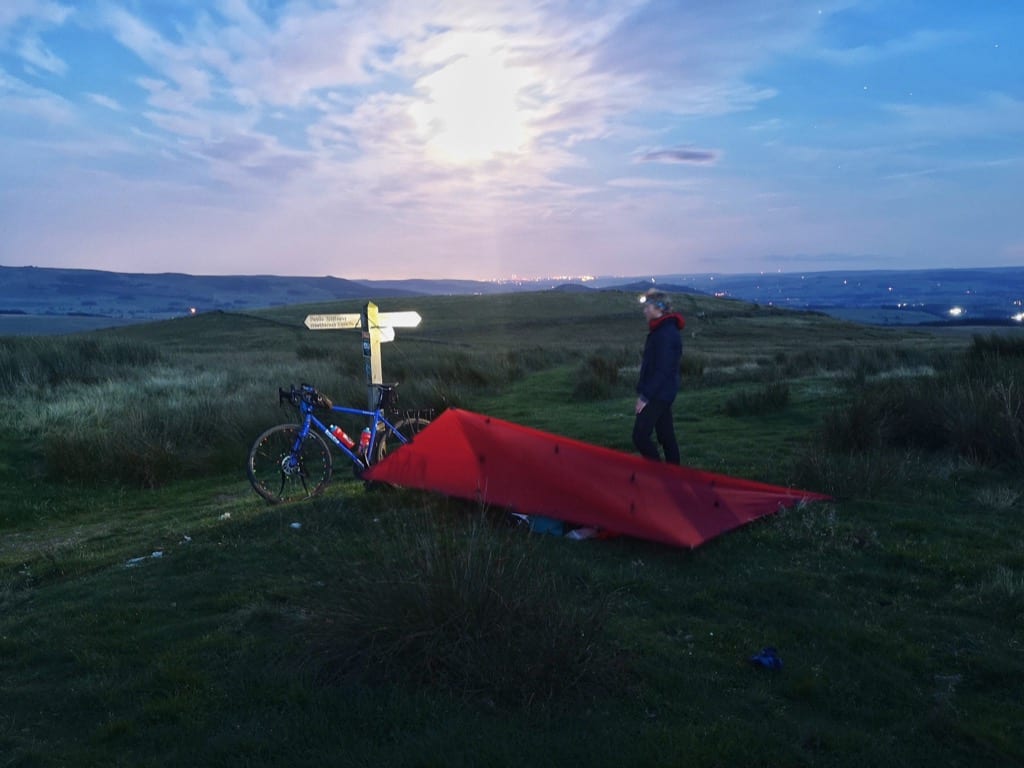
In this zen state we lit the stove, started cooking the spaghetti and heating up the bolognaise, tossed in our foraged garlic leaves and opened a bottle of wine. It was an Argentinian merlot but such was the effect of our forest-bathing that I could easily convince myself that we had just squeezed it from woodland berries.
Moonlit forest
After the sun had gone down, we went back into the forest again. I had been keen to try a walk after dark, having listened to one of Clare Balding’s Ramblings podcasts in which she had joined a couple of ladies for a night walk, without torches, over the South Downs. The wood was right there. If not now, when?
In the twilight, we returned to the oak with five trunks. The air was cool, becoming cold, but the trunks were warm to the touch. We leaned against them again, and listened. The wind had dropped; only occasionally would there be gentle rustle far overhead. I could hear a blackbird and a song thrush. Sarah had tuned into a different sound: a light pattering very much like rain, although the sky was clear. Thousands of tiny somethings, imperceptible, except for that steady patter, were tumbling their way down from the tree tops, through the leaves and branches, to the forest floor.

The pathway that took us back through the wood towards the tent was very straight, and it created a long, straight slit in the canopy above. The moon, nearly full, hung in the narrow band of visible sky. We were walking straight towards it. The alignment seemed almost too good to be true; it was as if the wood had recognised it had an appreciative audience, and now it was just showing off.
The next day, after packing up the camp, we drove to the little village of Wyck Rissington, and walked from there into Bourton on the Water, which I may write about in another post.
Back to the travel blog

So, as this is supposed to be a travel blog, how did Wolford Wood rate as a campsite, and as a place to reconnect with nature? Well it was hard to fault on either count. While providing a much wilder camping experience than most, with no designated pitches, just a wildflower meadow for you to pick your spot in, it did have clean toilets, hot showers and washing-up facilities.
What makes it really special is the wood. Apart from the public footpath, access to the wood is private, so if, like us you happen to come on a weekend when there are no other campers, you are likely to have the wood to yourself. It made for an incredibly peaceful experience, and I don’t think it would have been much different even if the campsite had been full. I imagine it’s the kind of place where everyone ends up talking softly.