After days of cold north-east winds, the lure of bright sunshine and a warm, spring-scented breeze was strong this morning. Immediately after dropping the kids off at school, I got on my bike and cycled about ten miles, along country lanes and grassy bridleways, past woods, fields and wild-flower meadows blooming with buttercups and cow parsley, accompanied by the songs of chiffchaffs, thrushes, robins and skylarks, to small nature reserve which surrounds the mouth of a railway tunnel from a long-closed branch line. With me I had a bottle of water and a little, red hard-backed book which arrived in the post a few days ago.
I have recently been following one of those unexpected and enjoyable cultural threads where one newly-loved book, podcast, programme etc. introduces you to another, or maybe a song, or a film, which then points you to something else, and something else; an unplanned journey through previously undiscovered writers, artists, or musicians. This particular journey started with Robert Macfarlane’s book The Old Ways, which prompted me to search for podcasts featuring the author, which led me to the music of Johnny Flynn, and also back to the Edwardian poet Edward Thomas, and even further back to the creators, some of whose names have been lost to time, chosen by Edward Thomas to feature in his Pocket Book of Poems and Songs for the Open Air - the book I took with me on this cycle ride.
Thanks for reading! Subscribe for free to receive new posts and support my work.
The link that had led me to this book was a BBC Radio 4 programme from 2022, called ‘Edward Thomas and the Song of the Path’. It is simply an edited recording of Robert Macfarlane and Johnny Flynn taking a walk together in the footsteps of Thomas, each with a copy of his Pocket Book of Poems and Songs, hoping to find inspiration from both the book and their surroundings for a new song. As they walk, they choose a couple of poems to read from the book which seem to fit their location: one by a birch tree which is heaving in the near-gale, and another in a dark and eerie yew forest. We also get to eavesdrop on their conversation as they share and build early ideas for their new song, and we hear them performing the final version at the end of the programme. It was a lovely surprise when, as I listened to the song taking shape, I began to recognise it as one which I already knew and very much liked. I had first heard it a couple of years ago, when I tuned into live coverage of the 80th Anniversary of the Normandy Landings just in time to catch Flynn singing for a ceremony at the British Normandy Memorial. It is called ‘Song with no Name’ (presumably after ‘The Pub With No Name’ where they finished their walk, and which is also believed to be where Edward Thomas wrote his first poem), and it had grabbed me immediately: I found it haunting and moving. I took this minor coincidence as a sign that I was on a good thread which was worth following further.
The next step was to order my own copy of the Pocket Book of Poems and Songs, and take it with me as often as possible whenever I was out on an expedition.
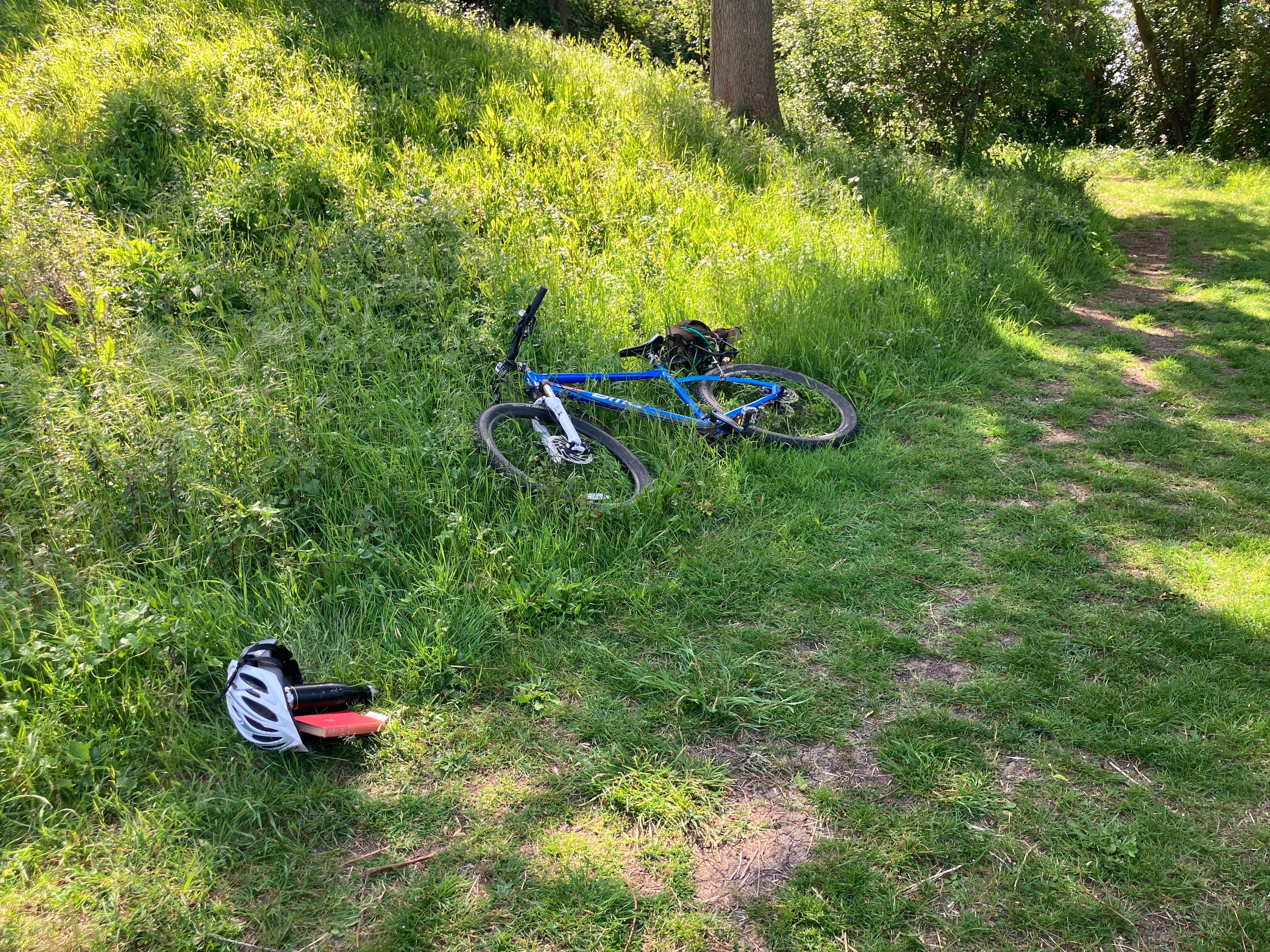
When I arrived at the nature reserve, I left my bike under a tree and continued on foot down the steps beside the tunnel mouth, to stand where the railway line had once been. It was cold there: a steady draft of air was blowing from the tunnel, cooled and dampened by its journey through the hillside, carrying wisps of mist which quickly evaporated when they met the sunshine. I climbed up the opposite cutting, back to where my bike lay, and sat down in the shade among the long grass and bryony (thank you Seek App for the identification), took the book from my bag and scanned the contents. The section called ‘The Footpath’ seemed a logical place to start and, with the spring chorus continuing in the trees and shrubs around me, the title of the second poem on the list looked encouragingly simple and appropriate: ‘Sweet Bird’ by William Drummond. Here it is:
Sweet bird, that sing’st away the early hours,
Of winters past, or coming, void of care,
Well pleased with delights which present are,
Fair seasons, budding sprays, sweet-smelling flowers:
To rocks, to springs, to rills, from leafy bowers
Though thy Creator’s goodness dost declare,
And what dear gifts in thee he did not spare,
A stain to human sense in sin that lowers.
What soul can be so sick, which by thy songs
(Attir’d in sweetness) sweetly is not driven
Quite to forget Earth’s turmoils, spites and wrongs,
And lift a reverent eye and thought to Heaven?
Sweet, artless songster, thou my mind dost raise
To airs of spheres, yea, and to angels’ lays.
I could hear my English teacher nudging me to count the lines and the syllables to confirm that this was a sonnet and to remember that a sonnet is, by convention, a love poem. This, therefore, must be intended as a love poem to songbirds; and that idea seemed rather more pleasing than a sonnet written for some long-passed lover or mistress. No need to try and imagine the face of whoever it was that Shakespeare compared to a summer’s day - here I was listening to near-enough the very same sounds that had stirred the feelings of William Drummond himself on the day he wrote the poem. And the centuries in between seemed to fold away.
The words of the poem, written around four-hundred years ago by someone who was troubled by ‘Earth’s turmoils, spites and wrongs’, were helping me, in 2026, to put aside the morning news, which had been worryingly full of evidence that we are drifting towards World War Three and worryingly sparse on concern that we are sleepwalking through climate-change tipping points, and find solace in the lush, blooming, singing life that surrounded me. For William Drummond, the birds seemed to have no concern for past or future: their song was a simple, exuberant celebration of life. For me, the reminder to appreciate ‘delights which present are’, and the feeling of sharing the enjoyment of a spring morning with another human from a distant century brought peace, perspective, and a thrill of time-travel.
When I lifted my ‘reverent eye’ to the sky, I could see a white and orange airliner, flying northwards. It was high-up, but leaving no contrail; a sunlit, sparkling arrow hurrying across the pure blue. Where was it going, I wondered - where were its passengers going? Glasgow or Edinburgh perhaps, or maybe further north - Keflavik? I looked at the green life around me and listened again to constant, vibrant birdsong and the breeze in the leaves. The people on that plane are missing out, was my first thought, a slightly smug one. But then, How do I know they’re missing out? They may be stuffed into an aeroplane now, and I don’t envy them that, but I don’t know what they enjoyed yesterday, or may enjoy later today, or tomorrow. All I know is that I don’t personally feel any urge in this moment to be anywhere else - I am content, here and now.
This was another step in my following of Mike Berners-Lee’s advice that, to protect our planet, we should ‘get better at enjoying things that don’t require much energy’. My little red pocket-book was, for me, a new way to get better at enjoying the world close to me. Many of the the people in that aeroplane were, no doubt, on their way to enjoy the world in different ways. But what they might be doing, and I might be missing out on, doesn’t really matter because I will never be able to take in everything that the world has to offer anyway - I have no choice but to miss most of it. I was, this morning, succeeding in enjoying the part of the world close to where I call home. And by doing that, I was falling more in love with where I live, making discoveries which could add richness to my life on an almost daily basis, feeling more connected, more content, more rooted, while also knowing that my choices were giving the rest of the world a better chance to thrive.
So what next? How might I continue to find all the adventure and enjoyment I need close by? I could leave this thread here, consider that I have ‘done’ Edward Thomas’s Pocket Book of Songs and Poems for the Open Air, and go in search of a new thread, starting with another book perhaps, to unlock another way to see. Or I could keep this book in my bag, and continue to delve into it whenever the fancy takes me, possibly until I know every word of every poem by heart. Either way, I am confident the rewards will keep coming, as long as I keep looking.